
PU Injection Waterproofing in Singapore: When Does It Work and When Does It Fail?

What is PU injection waterproofing?
Polyurethane (PU) injection, also called PU grouting, is a technique in which a suitable resin is injected through prepared ports into a crack, joint or void. Depending on its formulation and contact with moisture, the resin may react, expand and help seal the route through which water is entering. Different injection products have different properties, including reaction rate, flexibility and suitability for water-stopping versus long-term sealing.
In Singapore, PU injection is often considered for ceiling leakage, concrete cracks, basement seepage, retaining walls and selected inter-floor leakage situations. It can sometimes treat an accessible leakage path without removing an entire tiled surface above. However, success depends on diagnosing the actual source of water.
When does PU injection work?
1. Water entering through an identifiable concrete crack
When a crack is the actual seepage route, specialist injection may help block or seal it. Port locations, injection pressure, resin selection and crack continuity all matter. An observed crack is not automatically the original entry point, so an inspection comes first.
2. Leakage through selected construction joints or penetrations
Some joint and penetration details are suitable for injection systems designed for those conditions. Where a joint continues to move, the material and movement tolerance are important; a rigid solution may not be suitable.
3. Localised water seepage where access from one side is available
Injection may be considered from the leaking side when exposing the source surface is not feasible. This is sometimes described as a negative-side intervention, but it should not be confused with reconstructing the original positive-side membrane.
4. Emergency water-stopping followed by a permanent repair plan
Fast-reacting resins can help control active water ingress in some situations. Depending on the resin used and the defect, subsequent sealing or additional waterproofing may still be required.
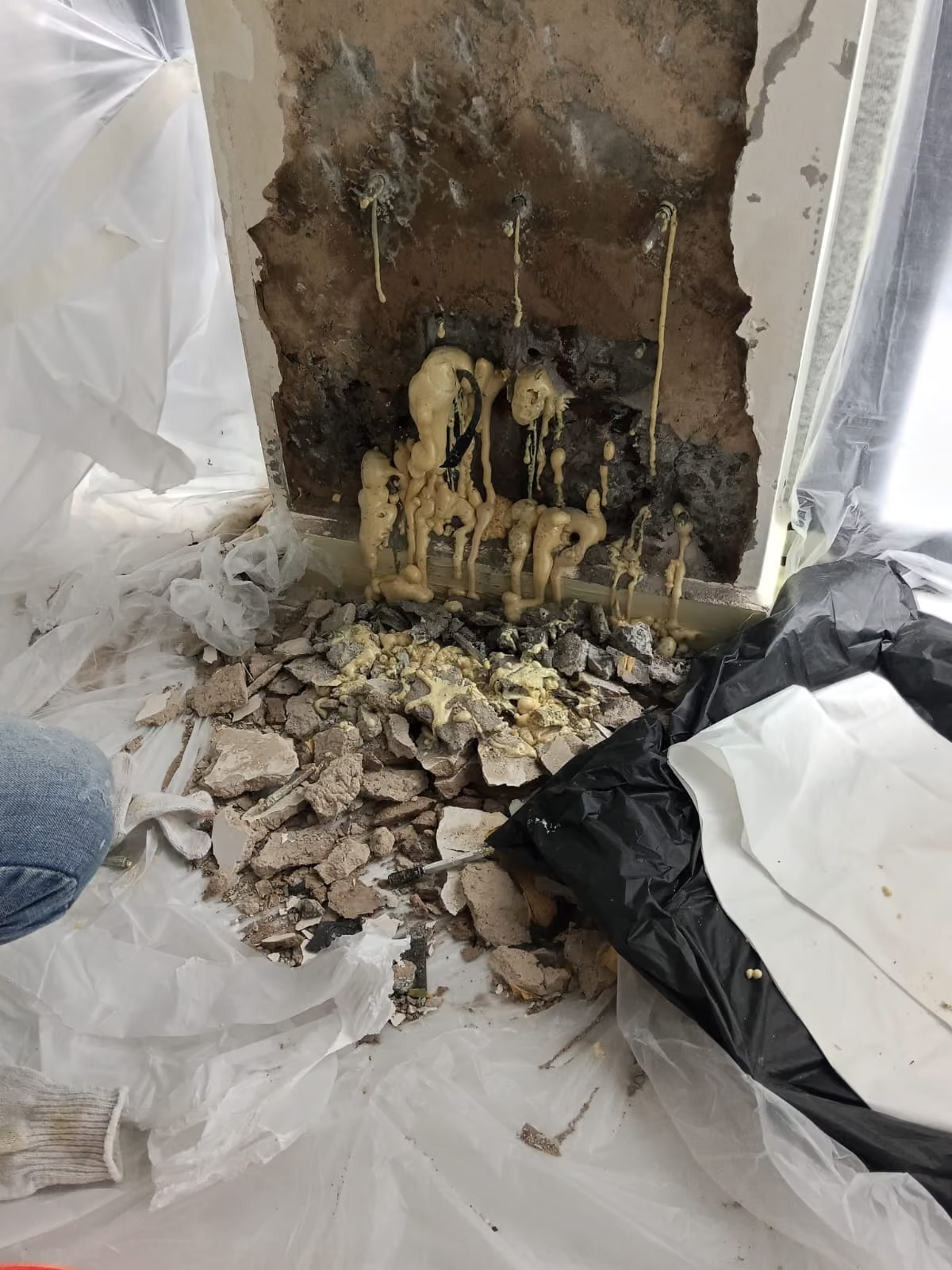
When can PU injection fail?
1. The membrane above is failing across a large area
Imagine a condo bathroom where the waterproofing membrane beneath many tiles has deteriorated. Sealing one visible ceiling crack may redirect the water to another weak point. If water enters over a broad wet area, properly renewing the membrane may be the more durable solution.
2. The leak is actually caused by plumbing
Concealed supply pipes, waste pipes, floor-trap connections and aircon discharge issues require diagnosis and often plumbing-related repair. Injection into surrounding concrete does not fix a damaged pipe itself.
3. The wrong resin is used for the leak condition
Some resins are formulated primarily for rapid water-stopping; others are designed to remain flexible or provide a different type of seal. Using a material outside its intended application, or injecting into an unsuitable substrate, may produce a short-lived result.
4. Injection does not reach the actual leak pathway
Water can travel along embedded conduits, joints, voids or reinforcing steel before appearing at a ceiling. Treating the visible exit point rather than the entry route may leave active seepage elsewhere.
5. Structural movement, cracks or workmanship issues continue
Further movement, insufficient injection coverage, poor port installation, unsuitable pressure or missed sections of the crack can contribute to recurrence. Even a well-executed injection has application limits.
PU injection versus full waterproofing replacement
For more treatment comparisons, see PU injection vs membrane vs overlay and why no-hacking waterproofing may not work.
Does PU injection work for condo inter-floor leakage?
Sometimes. If the leakage follows a repairable crack or joint, targeted PU injection may help. If water is entering through a widespread failed bathroom waterproofing membrane, a leaking pipe or a defective floor-trap connection, other repairs may be required. Coordination between the upstairs and downstairs units is often important to confirm the source and assess the options.
Triton Construction has experience working on condominium and MCST-related projects, including properties managed by Knight Frank, PFS, Savills and Ohmyhome. See our dedicated condo inter-floor leakage investigation and repair service.

How Triton assesses a leak before recommending injection
- Map the symptoms: identify when dripping occurs, its location and whether it relates to rain, showering or constant plumbing pressure.
- Inspect accessible surfaces: look for cracks, joints, tile defects, wet areas, pipes and drainage connections.
- Identify the likely source: determine whether the issue is localised or points to wider waterproofing failure.
- Choose a suitable repair: consider injection, joint sealing, pipe repair, membrane reinstatement or further investigation as appropriate.
- Set expectations: explain the proposed repair scope, monitoring steps, limitations and any applicable warranty in writing.
Frequently asked questions about PU injection waterproofing
Is PU injection a permanent waterproofing solution?
It can provide a durable seal in suitable conditions, but longevity depends on the material, crack or joint movement, workmanship and whether other leakage paths remain. It should not be promised as a universal permanent fix.
Can PU injection stop active water leakage?
Some PU injection products are designed to react rapidly with water and can help stop selected active leaks. The resin and injection method must suit the site condition.
Can PU injection repair a leaking bathroom without hacking?
It may be appropriate for a localised crack or joint. It generally does not recreate a widespread failed membrane beneath bathroom tiles.
Why did the leak come back after injection?
Possible reasons include an untreated parallel crack, incorrect diagnosis, resin unsuitable for the site, ongoing movement or water entering from a different source.
Is PU injection suitable for basement and retaining wall leakage?
It can be considered for certain concrete cracks and joints, subject to the water pressure, substrate condition and correct product selection. Some conditions require broader waterproofing work.
How much does PU injection cost in Singapore?
Prices vary with accessibility, leakage severity, number of injection points, resin type and follow-up requirements. A site inspection is more useful than an arbitrary per-point quote without a diagnosis.
Does PU injection require drilling?
Typically, specialists drill and install injection ports to deliver resin into the selected leakage path. The details depend on the construction and repair plan.
Is PU injection better than waterproofing membranes?
Neither is universally better. They solve different problems. A targeted seal can work well for a crack, whereas a failed wet-area membrane may need reinstatement.
Leak Returned After a Previous PU Injection Repair?
If another contractor has treated the area but the water seepage continues, Triton Construction can assess the symptoms and discuss whether injection, waterproofing replacement or another repair is more appropriate.
WhatsApp Triton About Your Leak