
.png)
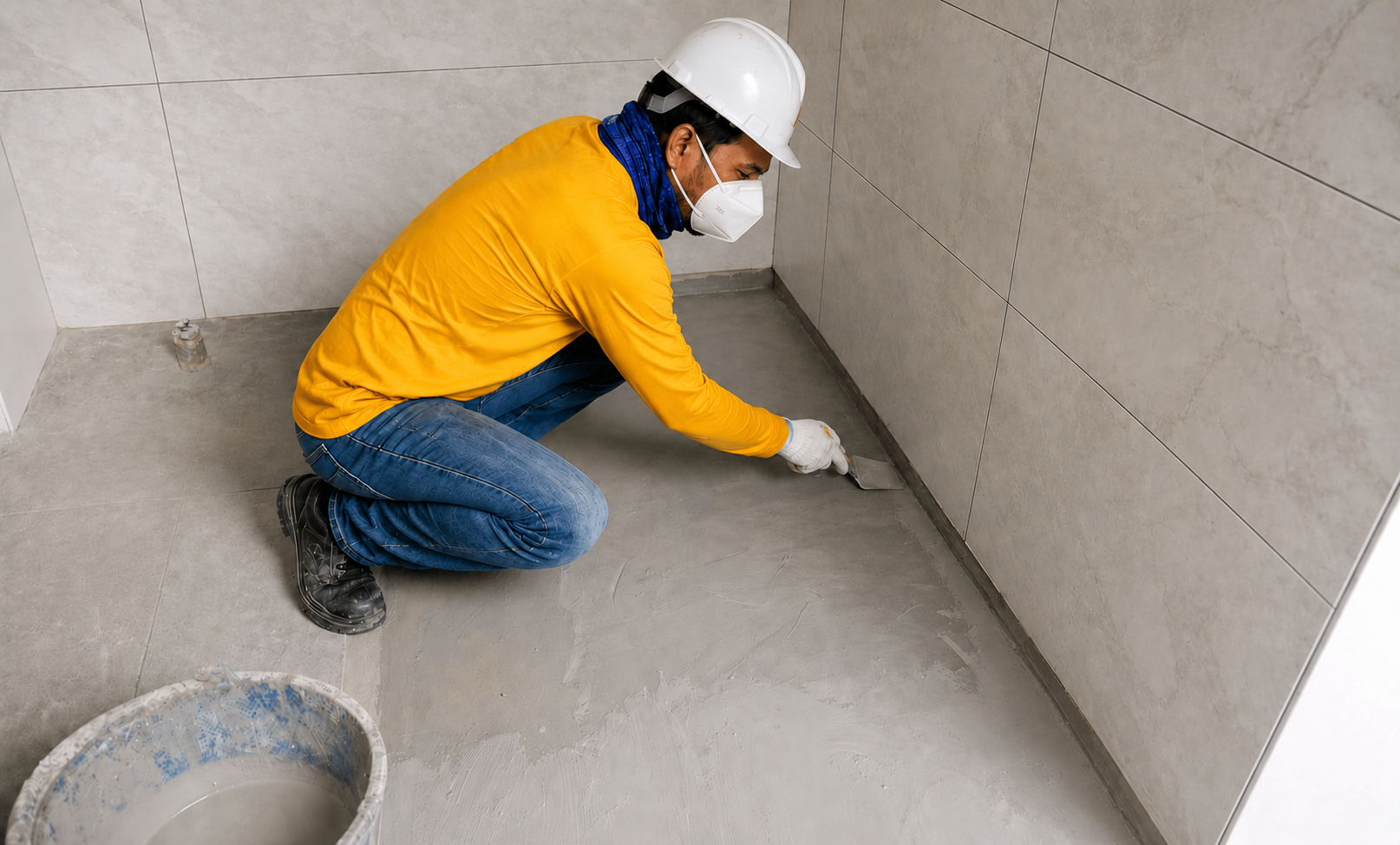
Short answer: Waterproofing must be completed and passed a ponding test before the screed and tiles go on — never patched in afterwards. In a Singapore high-rise, your bathroom floor is your downstairs neighbour's ceiling, and the waterproofing membrane is the single layer in the whole renovation you cannot fix without tearing everything above it back out. Plan it, budget for it, and verify it first.
If you only remember one thing from this guide, make it this: waterproofing is not a finishing touch. It is the foundation that every beautiful tile, vanity and rain shower sits on top of. Get it right once, and you may never think about it again for 15 to 20 years. Get it wrong, and you are looking at hacked tiles, a leaking ceiling below you, a strained relationship with your neighbour, and a four-figure repair bill — all for a layer you could not even see.
This article explains what "before" really means, where waterproofing sits in a correct renovation sequence, the Singapore-specific rules that make it non-negotiable, and how to make sure your contractor does it properly the first time.
"Before" works on three levels, and all three matter:
1. Before you finalise your design and budget. Waterproofing scope (floor, wall heights, shower zone, kerbs, floor traps, pipe penetrations) should be priced and specified at the quotation stage — not treated as a vague line item you discover later.
2. Before tiling, in the build sequence. Physically, the membrane is applied after demolition and plumbing rough-in but before the screed and tiles. Once tiles are down, the membrane is sealed away and invisible.
3. Before a leak forces your hand. Doing waterproofing properly upfront costs a fraction of what it costs to diagnose, hack, re-membrane and re-tile after water has already reached the unit below.
The most expensive waterproofing job in Singapore is the one you do after a leak. The cheapest is the one you do right the first time.
A properly run HDB or condo bathroom renovation follows a fixed order. Waterproofing is step four — and the work that comes after it literally buries it.
Notice that steps 6, 7 and 8 all sit on top of the waterproofing. That is the whole point: you cannot "add waterproofing later" without removing the screed and tiles first. There is no shortcut to a layer that lives underneath everything.
Waterproofing is the rare part of a renovation that is completely concealed the moment it is finished. You can see whether a tile is crooked or a vanity is scratched. You cannot see whether the membrane was applied in two full coats, whether the floor-trap upturn was detailed correctly, or whether the wall-floor junction was reinforced.
That invisibility cuts both ways:
In a landed home, a bathroom leak is your own problem. In Singapore's high-rise HDB flats and condominiums, it is a shared-boundary problem — and that changes the stakes entirely.
The slab between your bathroom and the unit below is a shared structural boundary. When your waterproofing fails, water does not just damage your floor — it tracks through the concrete and emerges as a ceiling leak in someone else's home. Ceiling leaks in Singapore overwhelmingly originate in wet areas (bathrooms and toilets) and are most common where the waterproof membrane and screed have worn out or were never done properly.
For HDB inter-floor leaks from natural wear and tear, repair is treated as a joint responsibility between the upper and lower flat owners. HDB's Goodwill Repair Assistance (GRA) scheme can soften the cost — typically HDB covers half and the two owners split the rest — but it specifically covers leaks from age and wear, and it does not cover damage to the lower unit's own fixtures and fittings.
The important nuance: if a leak is traced to a recent renovation in the upper unit, the goodwill framing weakens and the owner who renovated can be held fully responsible for the rectification. In other words, cutting corners on waterproofing during your renovation does not just risk your own floor — it can put you on the hook for your neighbour's ceiling, their damaged fittings, and the repair to the slab in between.
If you own a new Build-To-Order flat, you generally cannot hack the original bathroom floor or wall tiles for three years from the date of completion. This rule exists to protect the original waterproofing membrane HDB laid before handover, which is backed by a warranty against ceiling leaks. Hacking within that window disturbs a tested membrane before it has proven itself — and can shift full responsibility for any resulting leak onto you. Within those three years, overlaying new tiles on top is permitted; hacking is the prohibited action. (For resale flats and post-three-year BTOs, full hack-and-redo with fresh waterproofing is standard and often wise, since older membranes degrade after 15 to 20 years.)
The water ponding test is the single most important checkpoint in any bathroom renovation, and it is the practical reason waterproofing has to come before tiling.
After the membrane has been applied and fully cured, the floor trap is plugged and the bathroom floor is flooded with water, then left to stand for a set period while the contractor checks the slab and the ceiling of the unit below for any sign of seepage. Under BCA's CONQUAS framework, wet areas should be ponded for a minimum of 24 hours with no leakage before works continue; many quality renovation packages hold the water for 48 hours and document it with photographs.
The timing is everything. The test must happen after the membrane cures but before the screed and tiles are laid. Skip it, or rush it to save a day or two, and any defect stays hidden until water has already done its damage downstairs. A passing ponding test is your proof — ideally photographed, dated and witnessed by you — that the barrier works before it disappears under your floor.
A few non-negotiables to insist on:
The numbers make the "before" argument on their own. Figures below reflect prevailing Singapore market ranges and will vary with scope, materials and access.
Done before, waterproofing is a planned, modest part of your renovation budget. Done after a leak, it becomes an emergency that includes diagnostics, hacking, re-tiling, a second ponding test, and potentially your neighbour's repair costs and goodwill.
Prevention is not just cheaper — it is the only version that does not involve undoing finished work.
At Triton Construction, waterproofing is treated as the foundation of your bathroom renovation, not an afterthought. We work to Singapore's standards, document every stage, and never tile over an unproven membrane. Whether you are renovating a BTO, a resale HDB flat or a condo/landed bathroom — or you are already dealing with a ceiling leak — talk to us before the tiles go down.
[Contact Triton Construction for a waterproofing-first bathroom renovation →]