

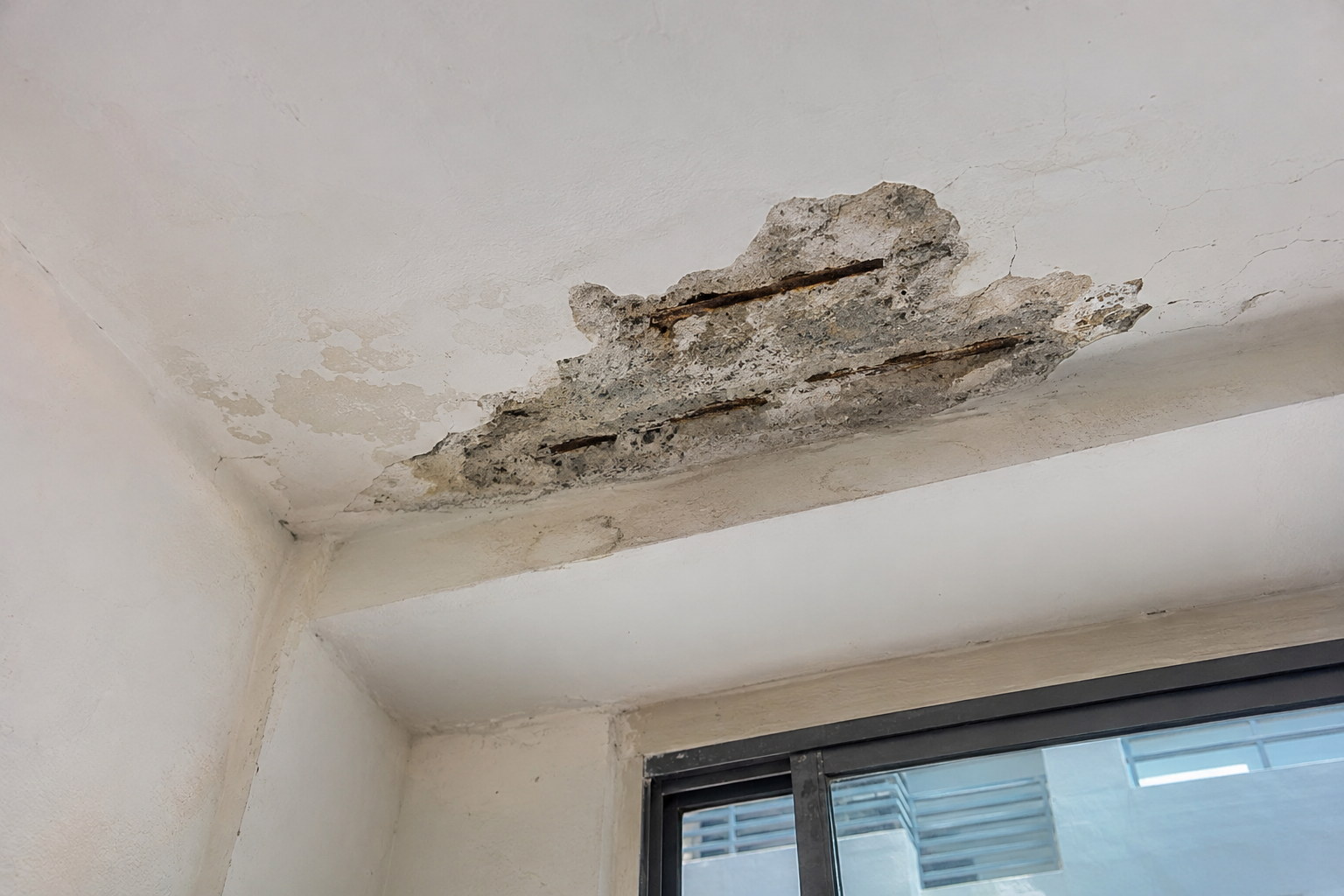
Spalling is the breakdown of a concrete surface, where it cracks, flakes or breaks away to expose the steel reinforcement bars underneath.
Reinforced concrete works because the two materials complement each other — concrete handles compression, steel handles tension, and the alkaline concrete surrounding the steel protects it from rusting. Spalling is what happens when that protection fails.
The mechanism explains why surface repairs never work:
By the time concrete is visibly flaking, the steel behind it has been rusting for years. The damage starts inside, not on the surface. This is why painting over spalling fails, and why a proper repair has to reach the steel.
Singapore’s climate accelerates every stage. High year-round humidity, annual rainfall above 2,300 mm and constant warmth mean concrete rarely dries out fully. HDB notes that spalling is a common issue in older buildings, made worse by damp conditions such as those in kitchens and toilets — which is exactly where it appears most, because steam and daily water use keep the slab permanently damp.
Most cases occur in flats over 20 years old. For flats completed before 1 January 1989, HDB conducts additional inspections at five-year intervals.
It’s worth keeping perspective: spalling affects roughly one percent of HDB flats. It is common enough to take seriously, not a crisis affecting most homes.
Yes, if left unrepaired. Loose concrete overhead can fall and injure someone, and the risk concentrates exactly where spalling is most common — bathroom and kitchen ceilings, directly above where people stand.
There’s a second reason not to wait. The affected area doesn’t stay the same size. Corrosion travels along the steel network, so the longer it runs, the more rebar is affected and the larger the eventual repair. What costs a few hundred dollars early becomes several thousand once it spreads.
HDB advises repairing spalling concrete promptly — handling it yourself if the area is small, or engaging a contractor for larger areas, before more concrete dislodges and causes injury.
If concrete is actively falling, treat it as urgent. Keep people clear of the area and get it assessed.
One further consideration for owners: spalling is a red flag during HDB resale inspections and can complicate a sale. Fixing it properly protects the value of the flat, not just the ceiling.
This is the most common and most expensive mistake homeowners make.
Painting over a spalling patch hides the stain for a few months and does nothing to the rusting steel behind it, which keeps expanding. Worse, a paint film can trap moisture against the slab, so the problem often returns faster than it would have otherwise.
The same applies to filler applied over the surface without removing the damaged concrete beneath. If loose, delaminated concrete remains, the new material has nothing sound to bond to and comes away with it.
A repair that lasts has to expose and treat the steel. Anything less is a cosmetic delay.
Each step exists for a reason:
1. Hack out all loose and delaminated concrete — back to sound material, not just the visibly damaged patch. Contractors sound the surrounding area by tapping to find concrete that has already debonded but hasn’t fallen yet.
2. Fully expose the affected rebar. The steel needs to be accessible all the way around, not just on its face. Rust on the hidden side will keep working if left.
3. Clean the steel — all corrosion removed, typically by wire brushing or mechanical means, back to clean metal.
4. Apply an anti-rust or corrosion-inhibiting treatment to the exposed reinforcement. This is the step that actually stops the process rather than covering it.
5. Apply a bonding agent so the repair material adheres to the existing concrete.
6. Patch with polymer-modified repair mortar, built up and finished to match the surrounding surface.
7. Cure properly, then paint or coat.
One refinement worth asking about. HDB applies an enhanced corrosion-resistant repair method in toilets under later Home Improvement Programme batches, where a corrosion-retardant coating goes across the entire toilet ceiling rather than only the repaired patch. The logic: the conditions that caused spalling in one spot exist across the whole ceiling, so treating only the visible damage leaves the rest on the same trajectory. Ask whether your contractor does this.
This decides whether your repair holds.
Moisture is the fuel for corrosion. If the slab stays wet, rust continues regardless of how well the patch was done. So if spalling sits directly beneath a wet area — a bathroom, kitchen or balcony above — and keeps returning after repair, the real problem is the waterproofing above it. Repairing the ceiling again without addressing the source is money spent twice.
Three possibilities a competent contractor should distinguish:
Spalling that returns within a year or two is almost never a bad patch. It’s an untreated water source.
Pricing follows the extent of corrosion, not the size of the stain — because the stain shows where rust emerged, not how far it has travelled along the steel.
HDB’s position is direct — as the owner, you are responsible for the prevention and repair of any spalling concrete in your flat. HDB classifies spalling inside the unit as a maintenance issue, not a structural defect it rectifies free of charge. A lawyer interviewed on this point told AsiaOne that in most interior spalling cases, HDB’s stance that the homeowner is responsible is legally sound.
Many articles state spalling is shared 50/50 with your upstairs neighbour. That is incorrect, and acting on it will waste your time.
The 50/50 arrangement applies to inter-floor water leaks, because the slab between two flats is a party structure — your neighbour’s floor and your ceiling at once — so repairing a leak through it is a joint responsibility. Under the GRA scheme for an inter-floor leak, HDB co-pays 50% and the two households split the remaining 50% equally, at 25% each.
Spalling is different. The corroding rebar is inside your own ceiling slab, caused by carbonation and moisture over time. Your neighbour didn’t cause it and isn’t party to it. HDB also co-pays for spalling, but the balance falls to the affected resident alone rather than being split between two flats.
There’s a second, more consequential error circulating. Several sites state that under GRA the flat owner’s share is “capped at $300.” That has the cap on the wrong side. According to HDB, HDB co-pays 50 per cent of the cost of repairs, up to $300 per flat — the $300 is a ceiling on HDB’s contribution, not on yours.
The difference is substantial:
If a leak from the unit above is keeping your slab wet and driving the corrosion, then the leak repair is an inter-floor matter and follows those rules — while the spalling repair in your ceiling remains yours. In practice these are often handled together, which is exactly how the confusion started.
Spalling in corridors, void decks, external walls and other common property is not yours — it falls to the Town Council. Report it to them rather than engaging a contractor yourself.
Check your by-laws, since developments differ on where the boundary sits, and involve the managing agent early if the spalling is near that line.
The owner is responsible throughout. Party walls and shared boundary structures can involve a neighbour, depending on where the defect sits.
Prevention works unusually well here, because the driver is moisture you can control.
Spalling concrete is a symptom. Whether it’s simple carbonation in an ageing slab or a failed waterproofing membrane keeping your ceiling permanently wet decides whether one repair is enough.
Triton Construction inspects what’s above the spalling before quoting what’s below it — so you fix the cause, not just the surface. We handle concrete repair and the waterproofing rectification that often goes with it, across HDB flats, condominiums and landed property.
WhatsApp Triton Construction for a non-obligatory quote, or contact Triton Construction for an on-site assessment.