
.png)
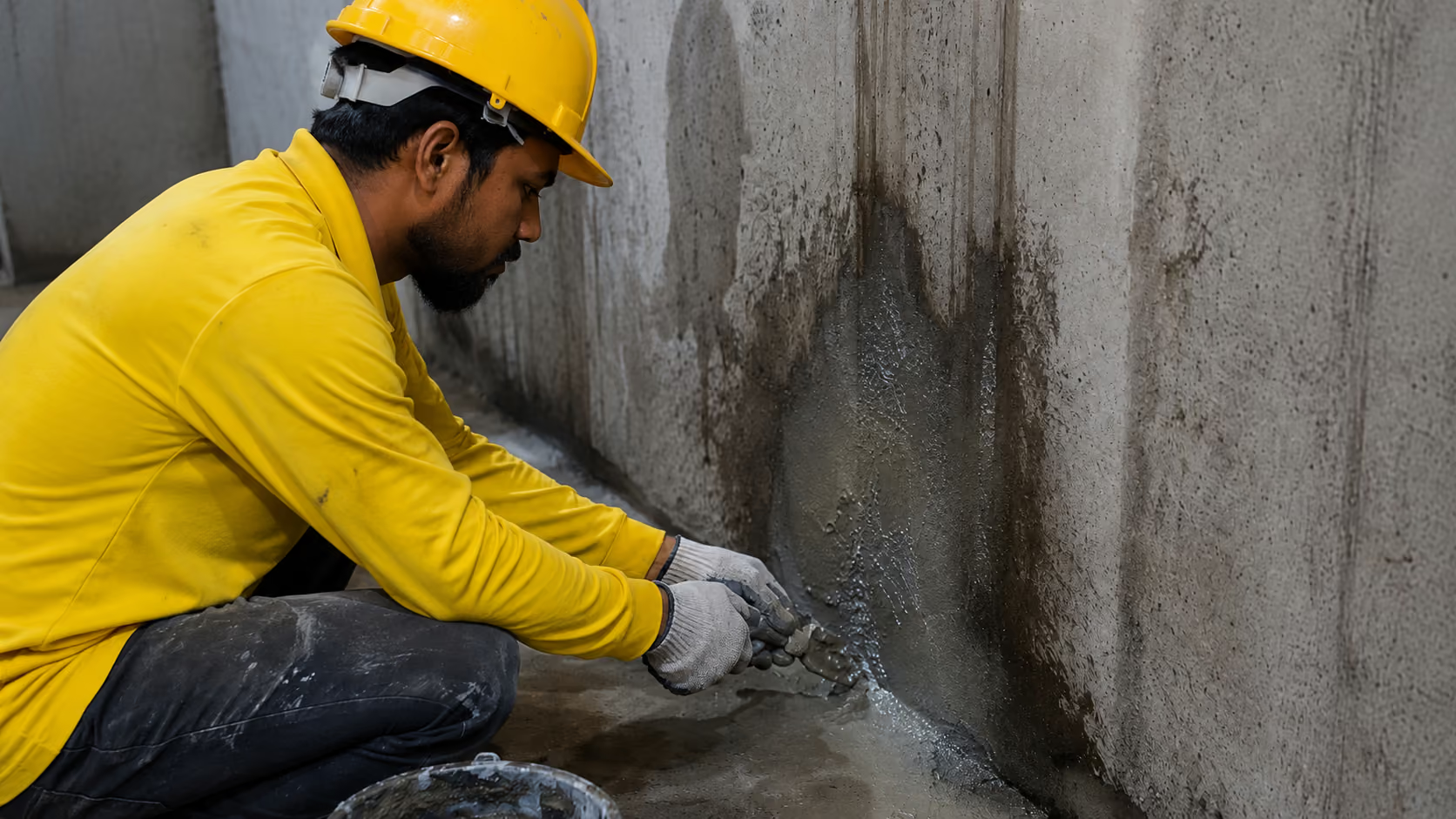
Water stains creeping up a basement wall. Damp patches below a planter box. White powdery streaks running down a retaining wall. In Singapore, these three problems show up again and again — and they share one root cause: water sitting against concrete that was never fully protected, or whose protection has failed.
Unlike a roof leak that appears only when it rains, below-ground and soil-retaining structures face water pressure almost continuously. That is what makes basement, planter box and retaining wall leaks harder to diagnose, harder to fix with DIY methods, and far more damaging when ignored.
This guide explains why these leaks happen in Singapore's climate and soil conditions, how professionals actually repair them, and when you should call a waterproofing specialist.
Three local conditions work against basements, planter boxes and retaining walls:
1. Intense, year-round rainfall. Singapore receives heavy rain throughout the year, with the Northeast Monsoon (roughly November to January) bringing prolonged downpours. Every storm recharges the soil with water, which then presses against any buried concrete structure.
2. High groundwater and saturated soil. Many parts of Singapore sit on clay-rich or reclaimed soil that drains slowly. After heavy rain, water lingers in the ground for days, keeping constant hydrostatic pressure on basement walls and retaining structures. Water under pressure will find any crack, joint or porous patch of concrete.
3. Ageing waterproofing membranes. Most below-ground waterproofing is applied on the soil-facing (positive) side during construction. Once the building is complete, that membrane is buried and inaccessible. When it degrades — typically after 10 to 20 years, or earlier if poorly installed — water reaches the concrete directly, and there is no way to simply "reapply" the original membrane without major excavation.
Basement leaks in Singapore usually trace back to one or more of the following:
Water in saturated soil exerts pressure on basement walls and slabs. It enters through shrinkage cracks, construction joints (where two concrete pours meet), tie-rod holes and pipe penetrations. These are the weakest points in any basement, and they are almost always where seepage first appears.
If the original membrane was poorly lapped, punctured during backfilling, or has simply aged out, the concrete itself becomes the only barrier — and concrete is porous.
Poorly compacted concrete contains voids (honeycombing) that act as channels for water. This is common in older buildings and rushed construction.
Even without visible water, moisture can wick upward through the slab and lower walls, causing peeling paint, musty odours and mould at the base of basement walls.
Warning signs to look for: damp patches that grow after rain, white crystalline deposits (efflorescence), bubbling or peeling paint, musty smell, mould at wall–floor junctions, and in severe cases, visible dripping or ponding water.
Planter boxes are one of the most underestimated leak sources in Singapore condominiums, landed homes and commercial buildings. They are effectively small water tanks filled with soil — permanently wet, directly attached to the building, and often sitting above habitable rooms.
Common causes include:
The telltale sign: a stained or damp ceiling, wall or beam directly below or beside a planter box, often worse a day or two after heavy rain or watering.
Retaining walls hold back soil — and the water in it. Leakage shows up as damp patches, water streaks, algae growth or heavy efflorescence on the exposed face.
Typical causes:
Beyond cosmetics, persistent water in a retaining wall corrodes the steel reinforcement inside, leading to spalling concrete — cracked, bulging patches where rusting rebar has expanded. Left long enough, this becomes a structural and safety issue, not just a waterproofing one.
Surface-level DIY products — waterproof paints and sealers from the hardware store — treat the symptom, not the source. Because basements, planters and retaining walls face pressurised water from the soil side, coatings applied casually on the inside face tend to blister and peel within months as water pushes through from behind.
DIY is reasonable for maintenance tasks: keeping planter drainage outlets clear, unblocking weep holes and re-sealing minor hairline surface cracks. But active seepage, recurring damp patches, efflorescence and any sign of spalling call for professional diagnosis, because injecting the wrong material — or injecting the right material in the wrong place — wastes money and can mask the problem while damage continues inside the concrete.
Costs vary widely with access, severity and method. As a general guide, localised PU injection for a crack or joint is the most economical option and can often be completed within a day. Planter box re-waterproofing costs more because it involves emptying the planter, membrane installation and a flood test. Retaining wall works range from simple drainage clearing to combined injection, coating and concrete repair for badly deteriorated walls.
The one consistent rule: early repair is always cheaper. A leak that costs a few hundred dollars to inject today can become a spalling-repair and re-waterproofing project costing many times more within a few years.
Basement, planter box and retaining wall leaks never resolve on their own — soil-side water pressure guarantees they only spread. The good news is that most can be permanently repaired from the inside, without hacking or excavation, when diagnosed correctly.
Triton Construction has specialised in solving complex water leakage problems in Singapore for many years, including basement seepage, planter box failures and retaining wall leaks that other contractors couldn't resolve. Our team uses PU injection grouting, membrane systems and crystalline waterproofing tailored to the actual source of your leak — confirmed by an on-site assessment, not guesswork.
👉 Seeing damp patches, efflorescence or ceiling stains? Contact Triton Construction for a professional on-site assessment. Call/WhatsApp +65 9111 5778 or email weijie@tritoncon.sg.